
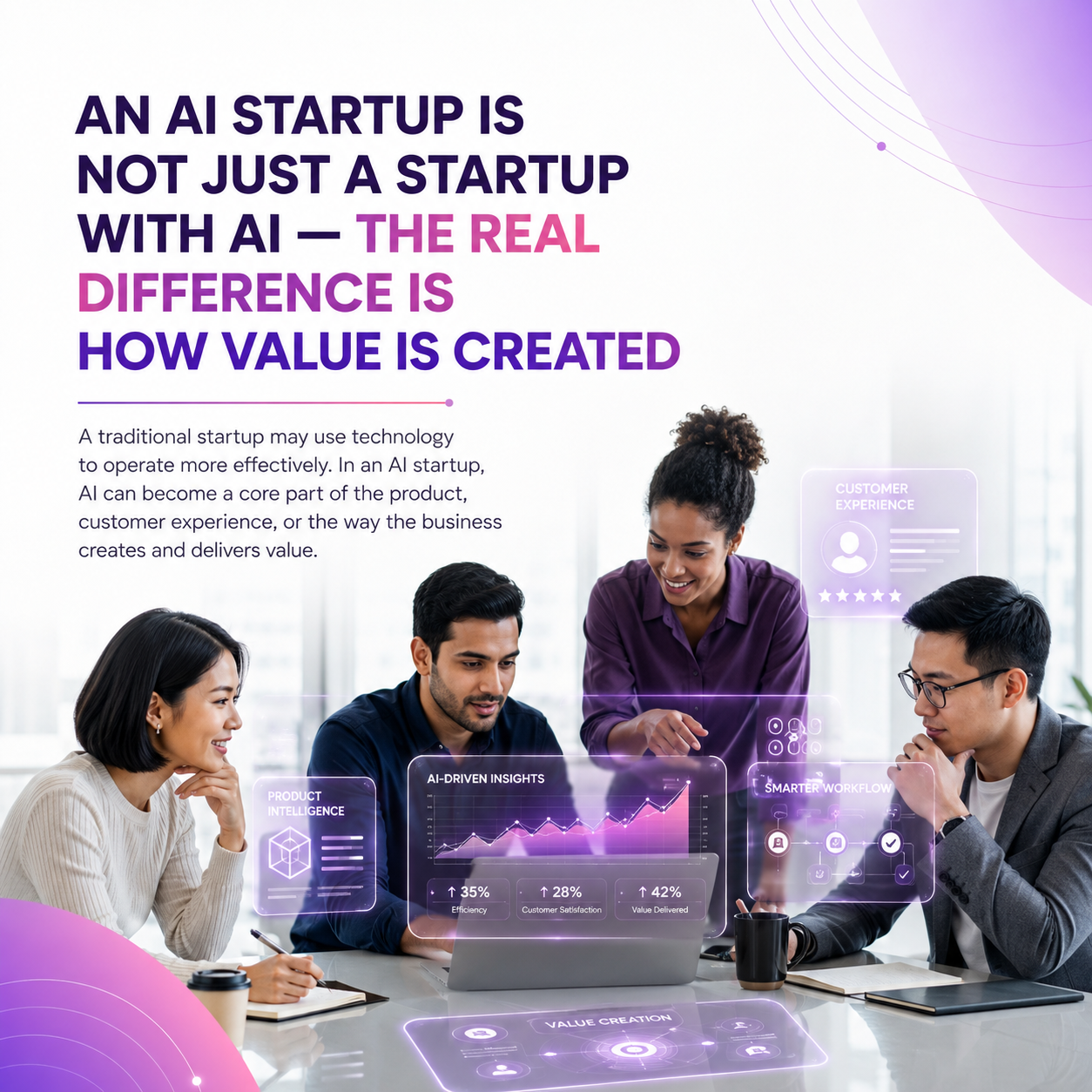
AN AI STARTUP IS NOT JUST A STARTUP WITH AI — THE REAL DIFFERENCE IS HOW VALUE IS CREATED
A traditional startup may use technology to operate more effectively. In an AI startup, AI can become a core part of the product, customer experience, or the way the business creates and delivers value.
Using AI Does Not Automatically Make a Business an AI Startup
A startup uses ChatGPT to draft marketing content.
Another installs an AI chatbot for customer service.
A third uses AI to summarize meetings and analyze internal documents.
Are they all AI startups?
Not necessarily.
Today, almost any company can integrate AI into daily operations. The more important distinction is not whether a startup uses AI, but what role AI plays in creating customer value.
For many traditional startups, AI is an enabling technology. It may improve productivity, reduce repetitive work, accelerate analysis, or support employees.
In an AI startup, however, AI may be much closer to the core value proposition.
Without the AI capability, the product, experience, or business model could be fundamentally different.
That distinction changes how founders need to think.
Both Start With a Real Customer Problem
AI startups and traditional startups still share the same fundamental starting point:
Problem → Customer → Solution → Business Model
AI does not remove this logic.
A sophisticated model cannot compensate for a problem customers do not care about.
An impressive AI demonstration does not automatically create demand.
And technical innovation does not guarantee that customers will pay.
Before asking what AI can do, founders should ask:
- What problem are we solving?
- Who experiences this problem?
- How important is it?
- How is it being solved today?
- Why would customers change their current behavior?
- What measurable or meaningful improvement could our solution provide?
Only then should AI enter the discussion.
The better question becomes:
Can AI help solve this problem in a way that is meaningfully better?
AI Must Create More Than Technical Novelty
Imagine two companies offering similar services.
One adds AI because the technology is popular.
The other uses AI to significantly reduce processing time, personalize an experience, extract useful insights from complex information, or make a previously difficult service more accessible.
Both companies “use AI,” but AI has a very different strategic role in each.
This is why founders should distinguish between AI as a feature and AI as a value-creation capability.
Customers usually do not buy artificial intelligence simply because it is artificial intelligence.
They buy outcomes.
They want something faster, easier, more accurate, more useful, more convenient, or better suited to their needs.
The technology matters when it improves the value customers actually experience.
Data Becomes Part of the Business Architecture
AI startups also need to think differently about data.
What information does the system require?
Where will that information come from?
Is the data sufficiently relevant and reliable for the intended use?
Do customers have appropriate expectations about how their information is handled?
What permissions, privacy safeguards, security measures, or contractual requirements apply?
How will data quality affect the AI output?
These are not merely technical questions.
They influence product design, customer trust, operating processes, risk management, and sometimes the economics of the business.
A startup that depends heavily on AI therefore needs to think about data strategy and AI strategy together.
AI Output Creates a New Quality Question
Traditional software often follows predefined rules.
AI systems, particularly generative systems, can produce outputs that vary and may sometimes be inaccurate or inappropriate.
That creates another design challenge:
How will the startup know when the AI output is good enough?
The answer depends on the use case.
Generating several marketing ideas carries a very different level of risk from providing information that influences a significant financial, employment, legal, medical, or safety-related decision.
Founders need appropriate evaluation methods, quality standards, monitoring, escalation paths, and human review.
The objective should not be to remove humans from every process.
It should be to determine where AI autonomy creates value and where human judgment remains necessary.
The Economics Can Be Different
AI startups also need to pay close attention to unit economics.
An AI feature may look impressive during a product demonstration but become expensive when thousands of customers begin using it.
Depending on the architecture, costs may include model usage, computing infrastructure, data processing, storage, monitoring, integration, security, human review, and ongoing development.
Founders therefore need to understand questions such as:
- How much does each AI interaction cost?
- How does usage change as customers become more active?
- Does serving another customer improve or weaken the margin?
- Can the product deliver enough value to support its pricing?
- Can smaller or more efficient models handle some tasks?
- Should every workflow use the most capable model?
AI capability and business viability must evolve together.
AI Changes the Build–Measure–Learn Cycle
One of the advantages of modern AI is the ability to prototype certain ideas more quickly.
Founders may be able to test interfaces, workflows, personalized experiences, content systems, internal processes, or early product concepts without building every component from the ground up.
But faster building should not mean faster assumption-making.
The real opportunity is to accelerate learning.
Build a focused experiment.
Put it in front of the right users.
Observe behavior.
Collect feedback.
Measure the outcome.
Then decide what deserves further investment.
AI can shorten parts of the experimentation cycle, but customers still determine whether meaningful value exists.
The Human Role Does Not Disappear
As AI becomes more capable, founders may be tempted to automate as much as possible.
That is not always the best design.
Some activities benefit strongly from human empathy, accountability, contextual judgment, creativity, negotiation, relationship building, and strategic thinking.
An AI startup should therefore ask:
What should AI do, what should humans do, and how should they work together?
In some workflows, AI may generate the first output while a person reviews it.
In others, AI may organize information while a human makes the decision.
For lower-risk and highly standardized tasks, automation may handle more of the workflow.
The right operating model depends on the consequences of error, customer expectations, and the nature of the task.
AI Is Not Automatically a Competitive Advantage
Access to powerful AI models is becoming increasingly widespread.
If competitors can use similar models and tools, simply integrating AI may not create a durable advantage.
The stronger advantage may come from what surrounds the technology:
- Proprietary or differentiated data.
- Deep customer understanding.
- A better workflow.
- Specialized domain knowledge.
- Superior user experience.
- Strong distribution.
- Trusted relationships.
- Efficient operations.
- Faster learning.
A business that combines these elements effectively may be much harder to copy than one built around a generic AI feature.
The strategic question is therefore not simply:
“Which AI model are we using?”
It is:
“What business system are we building around this capability that customers will continue to value?”
AI Startup Thinking Requires More Than Technical Thinking
Founders building AI startups need to connect several dimensions:
Customer + Problem + Value + Business Model + Process + Data + AI + Human Oversight
Ignoring any one of these can create weaknesses.
Strong technology without customer demand becomes an interesting experiment.
Customer demand without viable economics becomes difficult to scale sustainably.
Automation without process clarity can accelerate inefficiency.
AI without appropriate oversight can introduce unnecessary risk.
Data without governance can damage trust.
The startup must work as a system.
Final Thought
An AI startup is not simply a traditional startup with an AI feature added to the product.
The deeper difference appears when AI changes how customer value is created, delivered, improved, or scaled.
But the fundamentals of entrepreneurship remain remarkably important.
Find a real problem.
Understand the customer.
Create meaningful value.
Test assumptions.
Design a viable business model.
Build responsible processes.
Understand the economics.
Learn from the market.
Then determine where AI can create an advantage that matters.
The most important question for an AI founder is therefore not:
“What can this AI technology do?”
It is:
“What important customer problem can we solve better because this AI capability now exists?”
That shift—from fascination with technology to disciplined value creation—is what can turn an AI experiment into the foundation of a real business.
