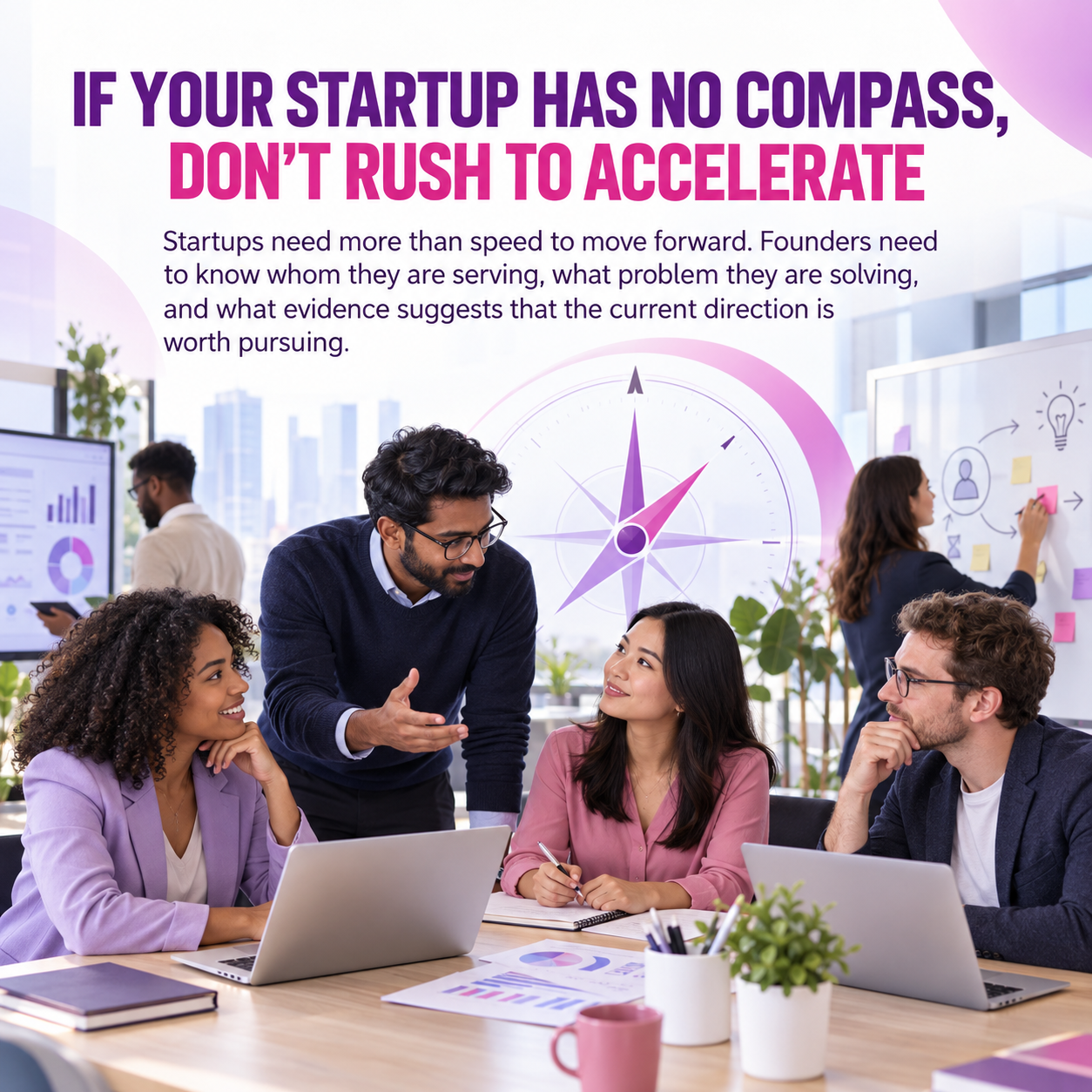
IF YOUR STARTUP HAS NO COMPASS, DON’T RUSH TO ACCELERATE
Startups need more than speed to move forward. Founders need to know whom they are serving, what problem they are solving, and what evidence suggests that the current direction is worth pursuing.
Speed Is Powerful — When the Direction Makes Sense
Startup culture often celebrates speed.
Launch faster. Build faster. Acquire customers faster. Adopt AI faster. Raise capital faster. Scale faster.
Speed matters because startups operate under uncertainty and usually have limited time, money, and resources. Moving quickly can help founders test assumptions and learn from the market.
But speed creates value only when it produces useful learning or moves the company in a promising direction.
If a startup does not clearly understand its customer, has not sufficiently investigated the problem, or cannot explain why its solution matters, acceleration can simply increase the cost of uncertainty.
Before asking:
“How can we move faster?”
A founder should first ask:
“Do we have enough evidence that we are moving in a direction worth pursuing?”
That is the startup compass.
A Startup Compass Is Not a Perfect Business Plan
Having direction does not mean predicting the future.
Early-stage startups cannot know exactly what customers will do, how competitors will respond, or which assumptions will survive contact with the market.
A useful compass is therefore not a rigid five-year plan.
It is a set of connected questions that helps founders decide what to test, what to learn, and what to do next.
A simple framework is:
CUSTOMER → PROBLEM → VALUE → VALIDATION → BUSINESS MODEL → GROWTH
Each element helps answer a different question.
Who are we serving?
What meaningful problem are we addressing?
What value are we proposing?
What evidence supports our assumptions?
How could the business create, deliver, and capture value?
What has become sufficiently repeatable to justify further investment?
Without this clarity, growth can become activity without direction.
1. CUSTOMER: Know Whom You Are Building For
One of the earliest mistakes a founder can make is defining the target customer too broadly.
“Our product is for everyone.”
It sounds ambitious, but it provides little strategic guidance.
Different customers have different needs, behaviors, budgets, expectations, and reasons for buying.
A startup needs enough customer clarity to answer questions such as:
Who experiences the problem most strongly?
Who is actively searching for alternatives?
Who makes the buying decision?
Who uses the product?
What triggers the decision to act?
What alternatives are customers already using?
The objective is not to create a fictional customer persona and treat it as fact.
The objective is to develop hypotheses about the customer and then investigate them through real evidence.
2. PROBLEM: Make Sure the Problem Deserves Attention
Founders naturally become excited about solutions.
Customers usually care first about problems and outcomes.
A technically impressive product can still struggle if the underlying problem is weak, infrequent, poorly understood, or not important enough for customers to change their behavior.
Before investing heavily in product development, ask:
How often does this problem occur?
How serious is it for the customer?
What happens if the customer does nothing?
How are customers solving it today?
What is frustrating about existing alternatives?
Are customers already spending money, time, or effort to solve it?
The stronger the evidence around the problem, the more informed the next product decision can become.
3. VALUE: Explain Why the Customer Should Care
A startup does not create value simply because it introduces a new feature or uses advanced technology.
Value exists in relation to the customer.
A solution might help customers save time, reduce cost, increase revenue, lower risk, simplify work, improve convenience, gain access, or achieve another meaningful outcome.
The founder should be able to connect three elements:
CUSTOMER NEED → PROPOSED SOLUTION → MEANINGFUL OUTCOME
This is especially important in an AI-driven environment.
Adding AI to a product does not automatically create customer value. AI is useful when it improves the solution to a problem that matters.
The strategic question is not:
“Where can we add AI?”
It is:
“Where can technology create meaningful value for this customer?”
4. VALIDATION: Replace Confidence With Evidence
Founder conviction can be valuable.
But conviction is not market evidence.
Friends saying an idea sounds interesting is not validation.
Social media engagement is not necessarily buying intent.
Survey respondents saying they “would probably use” something may not behave that way when they must spend money, time, or effort.
Validation should gradually move the startup from assumptions toward observable evidence.
Depending on the business, evidence may come from customer interviews, prototypes, landing-page tests, pilot programs, pre-orders, MVP usage, purchasing behavior, retention, or other appropriate experiments.
The objective is not to prove that the founder was right.
It is to learn what is actually true enough to guide the next decision.
A useful learning cycle is:
ASSUMPTION → TEST → EVIDENCE → LEARNING → DECISION
5. BUSINESS MODEL: Understand How the Pieces Work Together
Even a valuable product needs a workable business model.
Founders should understand how customer segments, value propositions, channels, relationships, revenue, resources, activities, partnerships, and costs connect.
A startup may attract users but struggle to monetize them.
It may generate revenue but have unsustainable acquisition costs.
It may have strong demand but insufficient operational capacity.
It may deliver excellent service but depend so heavily on the founder that growth becomes difficult.
This is why business-model thinking matters.
The question is not only:
“Can we sell this?”
It is also:
“Can we create, deliver, and capture value in a way that can support the business?”
6. BUILD: Start Small Enough to Learn
Once the customer, problem, and value hypotheses become clearer, the startup can begin testing solutions.
But early building should serve learning.
The objective is not necessarily to create the largest possible product.
It is to create enough of a solution to test important assumptions with appropriate users.
That may involve a prototype, manual service, limited pilot, MVP, or another experiment appropriate to the business.
The key question is:
What is the smallest meaningful test that can help us learn something important?
This approach can help preserve resources while uncertainty remains high.
7. MEASURE: Know What the Market Is Telling You
Founders can become surrounded by numbers without becoming more informed.
Website visits, followers, downloads, impressions, registrations, and likes may be useful in context, but they do not automatically indicate a healthy business.
The right metrics depend on the business model and stage.
Founders may need to examine measures such as conversion, activation, usage, retention, repeat purchase, customer acquisition cost, gross margin, revenue, or customer feedback.
The purpose of measurement is not to make the dashboard look impressive.
It is to answer:
What is changing, why might it be changing, and what should we investigate next?
8. ADJUST: Changing Direction Is Part of Learning
A startup compass does not mean staying on the original path regardless of evidence.
Sometimes the evidence tells the founder to adjust.
The customer segment may need to become narrower.
The problem may need to be redefined.
The value proposition may need to change.
The pricing model may be wrong.
The channel may be ineffective.
The product may contain features customers do not value.
Changing direction based on credible evidence is not necessarily failure.
It can be a sign that the startup is learning.
The danger is becoming so attached to the original idea that every signal from the market is interpreted as confirmation.
9. GROW: Scale What Has Earned the Right to Scale
Growth becomes more meaningful when important parts of the model have demonstrated some repeatability.
Before accelerating, founders should ask:
Do we understand why customers buy?
Are customers receiving the intended value?
Is there sufficient evidence of demand?
Can we acquire customers through identifiable channels?
Can we deliver consistently?
Do the economics make sense at the current stage?
Which processes will break if volume increases?
What still depends entirely on the founder?
Scaling does not eliminate uncertainty.
But it should not be used as a substitute for validation.
Increasing marketing spend, hiring rapidly, expanding geographically, or automating everything can magnify both strengths and weaknesses.
Scaling a strong process can create leverage. Scaling a weak process can create larger problems.
AI Can Increase Speed — Which Makes Direction Even More Important
AI allows startups to perform many activities faster.
Research can be accelerated.
Content can be drafted rapidly.
Data can be analyzed.
Customer-support workflows can be assisted.
Prototypes can be developed more quickly.
Routine processes can sometimes be automated.
This creates enormous potential, but it also introduces a new strategic risk:
Doing the wrong thing faster.
Founders still need to define the problem, evaluate outputs, protect sensitive information, understand customers, make consequential decisions, and remain accountable for how technology is used.
AI can increase leverage.
It cannot decide what business is worth building.
Final Thought: Direction Before Acceleration
There is nothing wrong with moving fast.
The question is what the speed is accomplishing.
A startup with no clear customer, weak problem evidence, an uncertain value proposition, and an untested business model does not necessarily become stronger by adding more marketing, more people, more technology, or more capital.
It may simply become more expensive and more complex.
A more disciplined path is:
UNDERSTAND → TEST → LEARN → ADJUST → BUILD → MEASURE → GROW
Your compass will never be perfect.
Markets change. Customers change. Technology changes. Competitors respond. New evidence appears.
The founder’s responsibility is not to know the entire road before beginning.
It is to maintain enough strategic clarity to decide what should be tested next — and enough humility to change direction when the evidence demands it.
So before asking:
“How can our startup move faster?”
Ask a more important question:
“What evidence tells us that this is the direction worth accelerating?”
Speed can take a startup farther.
Direction determines whether going farther is actually progress.
