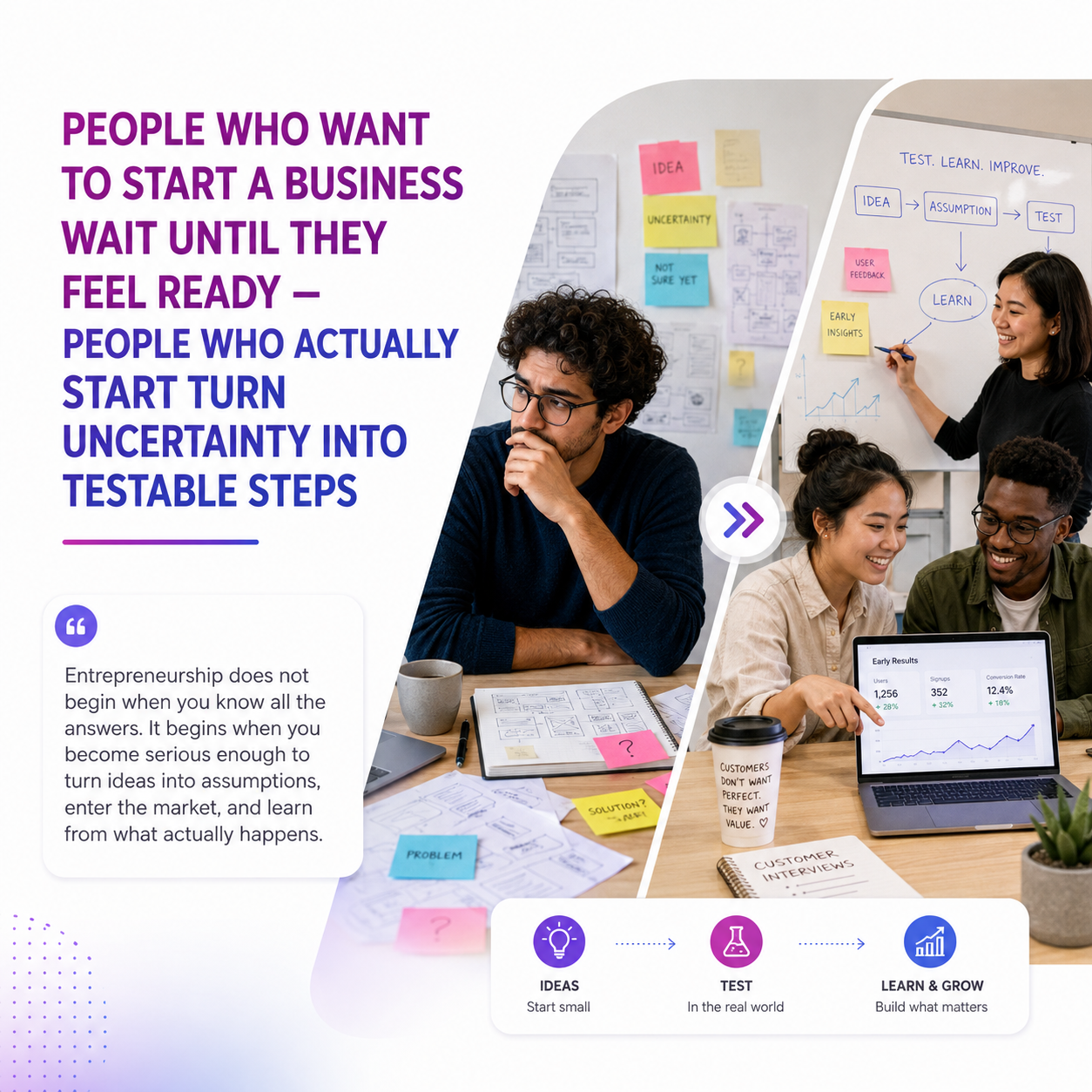
PEOPLE WHO WANT TO START A BUSINESS WAIT UNTIL THEY FEEL READY — PEOPLE WHO ACTUALLY START TURN UNCERTAINTY INTO TESTABLE STEPS
Entrepreneurship does not begin when you know all the answers. It begins when you become serious enough to turn ideas into assumptions, enter the market, and learn from what actually happens.
The Perfect Time to Start Rarely Arrives
“I want to start a business.”
For many aspiring founders, that sentence can remain an intention for months or even years.
They are waiting.
Waiting for the perfect idea.
Waiting for more capital.
Waiting until they understand the market completely.
Waiting until the product is finished.
Waiting until they finally feel confident enough to begin.
Preparation matters. Research matters. Financial planning matters. But entrepreneurship contains uncertainty that cannot always be eliminated before action begins.
At some point, the founder has to move from thinking about the market to learning from the market.
That is where entrepreneurship becomes real.
Founders Do Not Need Every Answer — They Need Better Questions
One of the biggest misconceptions about entrepreneurship is that successful founders begin with a complete plan.
In reality, an early-stage startup is often built around assumptions.
You believe a particular customer has a problem.
You believe the problem matters enough to solve.
You believe your proposed solution can create value.
You believe customers may choose it over existing alternatives.
You believe they may be willing to pay.
These are not automatically facts.
They are hypotheses that need evidence.
This changes the founder’s question from:
“Will my idea succeed?”
to:
“What assumption should I test first?”
The second question is much more useful because it creates something actionable.
Turn the Idea Into Testable Assumptions
An idea can feel exciting because it exists without resistance inside your imagination.
The market is different.
Customers have existing habits, budgets, alternatives, priorities, and expectations.
A useful first step is therefore to break the idea into assumptions.
For example:
Who is the target customer?
What specific problem are they experiencing?
How frequently does it occur?
How are they solving it today?
What is unsatisfactory about the current solution?
What outcome would they value?
Would they change their behavior for a better alternative?
Would they pay for it?
Each question creates an opportunity to learn.
Instead of betting everything on one large idea, founders can gradually test the assumptions supporting it.
Customer Discovery Comes Before Customer Acquisition
New founders often think about marketing very early.
How will I advertise?
Which social platform should I use?
How do I generate leads?
What should my website look like?
These questions matter eventually, but there is an earlier question:
Do you understand the customer well enough to know what you should be marketing?
Customer discovery is not simply asking people whether they like your idea.
People may be polite. They may encourage you. They may even say they would buy something without ever purchasing it.
Stronger discovery focuses on actual experiences and behaviors.
What happened the last time the customer experienced the problem?
What did they do?
What did it cost?
What alternatives did they consider?
Why did they choose the current solution?
What remains frustrating?
Founders should look for evidence, patterns, and behavior — not only compliments.
Build the Smallest Useful Experiment
Starting does not always mean building the complete product.
Sometimes the smartest first action is much smaller.
A landing page can test interest.
A prototype can test usability.
A manual service can test whether customers value the outcome before automation is built.
A structured interview can challenge assumptions about the problem.
A pilot can reveal how customers actually use the solution.
A minimum viable product can help test a critical part of the value proposition.
The objective is not to appear large.
The objective is to learn before committing unnecessary resources.
This is why early-stage execution should be designed around learning, not perfection.
Learn to Separate Signals From Noise
Not every piece of feedback should change the business.
One customer requesting a feature does not automatically mean the market needs it.
A social media post receiving attention does not necessarily prove willingness to pay.
Positive comments do not equal product-market fit.
Founders need to distinguish between encouraging signals and meaningful evidence.
Useful signals may include repeated customer problems, actual usage, willingness to participate in a pilot, repeat behavior, referrals, retention, or payment.
The appropriate evidence depends on the business model and stage of development.
The principle remains the same:
Do not confuse attention with validation.
Failure of an Assumption Is Not Failure of the Founder
Suppose you test an idea and discover customers do not care enough about the problem.
That may feel disappointing.
But it is also valuable information.
You have learned something before spending more time, money, and energy building around a weak assumption.
This is one of the most important mindset shifts in entrepreneurship.
A failed experiment can still produce useful learning.
The founder’s job is not to prove that every original assumption was correct.
The job is to discover what is true enough to make the next decision better.
Sometimes that means improving the solution.
Sometimes it means choosing another customer segment.
Sometimes it means changing the business model.
And sometimes it means deciding not to continue.
Stopping a weak direction can be a rational entrepreneurial decision.
AI Can Accelerate Testing — But It Cannot Validate the Market for You
AI gives modern founders powerful capabilities.
It can support market research, organize interview notes, generate prototype ideas, analyze patterns, draft experiments, create content, compare scenarios, and automate selected workflows.
This can reduce the effort required to move from idea to experiment.
But founders should understand the boundary.
AI can help you formulate a customer hypothesis.
It cannot make customers need your product.
AI can summarize market information.
It cannot replace direct evidence from your target market.
AI can help create a prototype quickly.
It cannot prove that people will consistently use or pay for it.
The strongest approach is therefore not:
AI instead of customer validation.
It is:
AI to accelerate preparation, experimentation, analysis, and learning — while real market evidence informs important decisions.
Build a Learning Loop, Not Just a Product
A startup should not be viewed only as a product under construction.
It is also a learning system.
A practical early-stage cycle might look like:
ASSUMPTION → EXPERIMENT → EVIDENCE → LEARNING → DECISION → NEXT EXPERIMENT
This creates discipline.
Instead of endlessly adding features, founders ask what needs to be learned.
Instead of spending months preparing for a perfect launch, they identify smaller opportunities to obtain evidence.
Instead of defending an original idea emotionally, they compare assumptions with what the market actually shows them.
Over time, uncertainty becomes more structured.
Not eliminated — structured.
That distinction matters because entrepreneurship will always contain unknowns.
Action Does Not Mean Acting Recklessly
“Just start” can be useful motivational advice, but it is incomplete.
Action without thought can waste resources.
Research without action can create paralysis.
The stronger approach sits between them:
Think enough to identify the important assumption. Act enough to test it. Learn enough to improve the next decision.
This is disciplined entrepreneurship.
The founder is neither waiting forever nor betting everything blindly.
They are converting uncertainty into manageable experiments.
Readiness Is Built Through Action
Many aspiring founders believe confidence must come before action.
Often, confidence develops through action.
You conduct the first customer interview.
You discover your assumptions were incomplete.
You improve your questions.
You build a simple prototype.
Someone uses it differently than expected.
You adjust.
A customer pays.
Another does not.
You investigate why.
Each cycle produces information.
And information gradually creates clarity.
You may never reach a moment when every uncertainty disappears.
But you can become increasingly capable of operating despite uncertainty.
That is a much more useful form of readiness.
Final Thought
The difference between someone who wants to become a founder and someone who begins building is not necessarily intelligence, money, confidence, or access to the perfect idea.
Often, the difference is the willingness to turn uncertainty into something that can be tested.
Do not wait until you know everything.
Define what you currently believe.
Identify the most important assumption.
Find the smallest responsible way to test it.
Talk to the market.
Observe behavior.
Collect evidence.
Learn.
Then decide what deserves the next investment of your time, money, and attention.
Entrepreneurship does not begin when uncertainty ends.
It begins when you develop a disciplined way to move through uncertainty without pretending it does not exist.
So instead of asking:
“When will I finally be ready?”
Ask:
“What can I test today that will help me make a better decision tomorrow?”
That question may not remove the uncertainty.
But it can turn an idea into action, action into evidence, and evidence into the next informed step.
