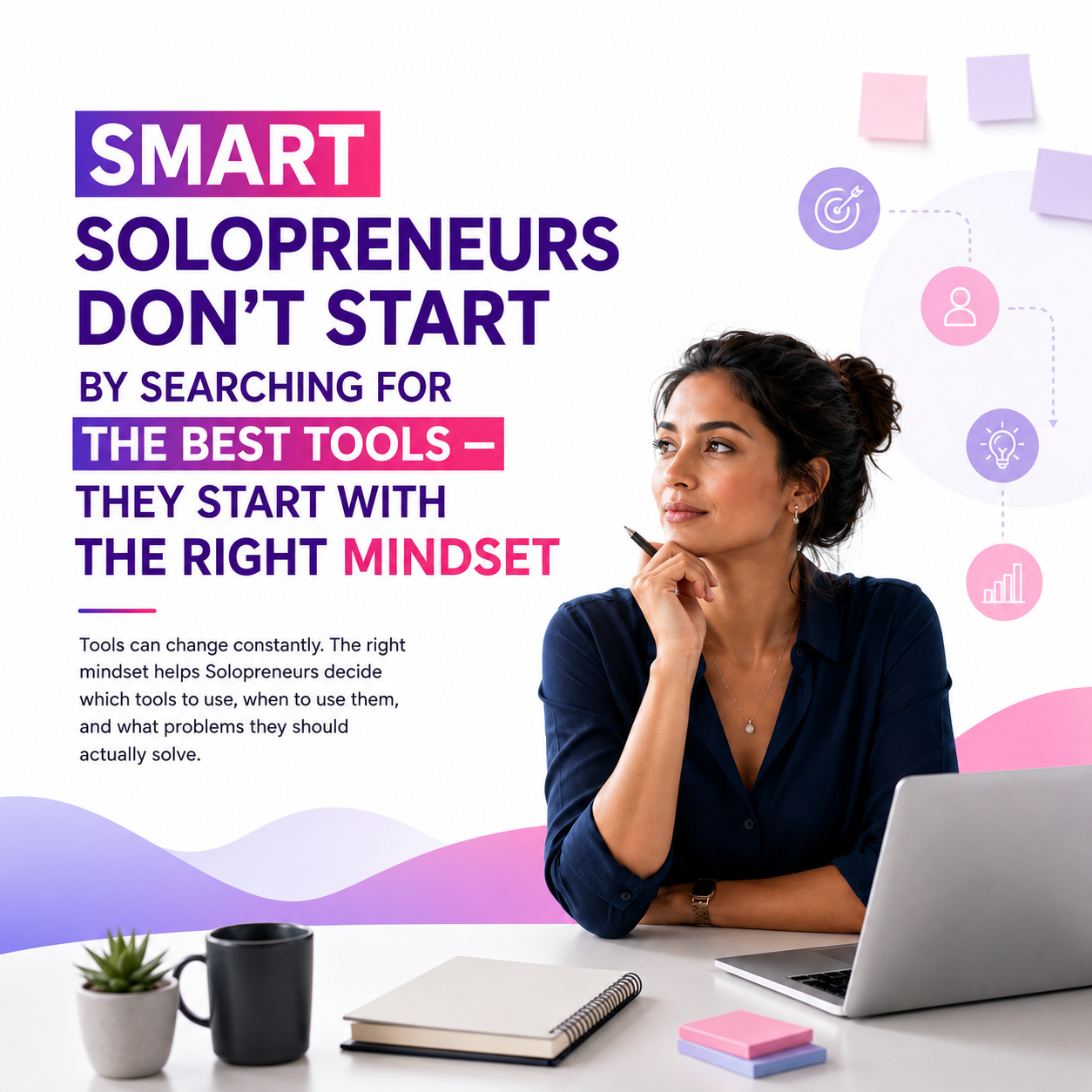
SMART SOLOPRENEURS DON’T START BY SEARCHING FOR THE BEST TOOLS — THEY START WITH THE RIGHT MINDSET
Tools can change constantly. The right mindset helps Solopreneurs decide which tools to use, when to use them, and what problems they should actually solve.
The Tool Is Rarely the Starting Point
Every week, another AI tool promises to help entrepreneurs work faster.
One writes content. Another creates images. Another automates emails, summarizes meetings, analyzes customer data, generates sales materials, or manages workflows.
For a Solopreneur, the opportunity is significant. Technology can reduce the time required for many tasks and make capabilities that once required larger teams more accessible to individuals.
But there is a hidden problem.
When tools become easier to access, it becomes equally easy to confuse having more tools with building a better business.
A Solopreneur can subscribe to ten platforms, automate dozens of activities, generate hundreds of pieces of content, and still struggle to find customers or create sustainable revenue.
Why?
Because technology can improve execution, but it cannot automatically determine what deserves to be executed.
That requires thinking.
Start With the Problem, Not the Platform
Before asking, “Which AI tool should I use?” ask a more fundamental question:
What problem am I trying to solve?
Perhaps customer research takes too long.
Perhaps leads are not followed up consistently.
Perhaps content production consumes too much time.
Perhaps customer inquiries repeat the same questions.
Perhaps administrative work prevents you from focusing on high-value activities.
Each situation may benefit from technology, but the appropriate solution depends on the actual problem.
Without that clarity, tool selection becomes driven by trends rather than business needs.
A new platform may look impressive because everyone is talking about it. But if it does not improve a meaningful business process, customer outcome, or decision, it may simply create another subscription and another system to manage.
Good technology decisions begin with business problems.
Know Your Customer Before Automating Your Marketing
AI can help Solopreneurs create content at remarkable speed.
But faster content does not automatically create better marketing.
If you do not understand your customer, AI may simply help you communicate the wrong message more efficiently.
Before increasing content volume, understand:
Who are you trying to reach?
What problem are they experiencing?
What outcome do they want?
What questions are they asking?
What prevents them from taking action?
What language do they use to describe their situation?
What makes them trust one solution over another?
Once these questions become clearer, AI can help organize research, explore messaging options, draft content, analyze feedback, and support experimentation.
The sequence matters.
Customer understanding first. Technology second.
A Weak Business Model Cannot Be Fixed With More Automation
Automation is powerful because it can make repeatable activities happen with less manual effort.
But that creates an important principle:
Do not automate something simply because it can be automated.
If a process is poorly designed, automation can make the poor process operate faster.
If an offer does not create enough customer value, automated marketing does not solve the underlying problem.
If customer acquisition costs are unsustainable, automating lead generation may increase volume without improving economics.
If customers are leaving because the experience is weak, adding another automated sequence may not address the real cause.
Before automating, simplify.
Before simplifying, understand.
Before scaling, validate.
Technology works best when it strengthens a business system that already has a clear purpose.
The Best Solopreneurs Think in Systems
A Solopreneur has one particularly scarce resource: personal capacity.
There are only so many hours available each day.
This makes systems thinking especially valuable.
Instead of asking, “How can I finish this task faster?” ask:
Why does this task exist?
Does it need to be done?
Can it be simplified?
Can it be standardized?
Can a template handle part of it?
Can technology support it?
Can it eventually run without my direct involvement?
This changes the role of AI.
Instead of becoming another collection of applications, AI becomes one component of a larger operating system.
The goal is not to remove the human from everything.
The goal is to use human attention where it creates the greatest value.
Know What AI Should Not Do
Effective AI adoption also requires boundaries.
Some activities depend heavily on judgment, accountability, empathy, context, trust, or strategic interpretation.
AI can support these activities, but the Solopreneur remains responsible for important decisions and outputs.
For example, AI may summarize customer feedback, but you still need to determine what that feedback means for your strategy.
AI may generate a proposal, but you need to verify its accuracy and ensure the promises are appropriate.
AI may produce market research summaries, but important claims should be validated against reliable evidence.
AI may suggest business decisions, but responsibility for those decisions remains human.
Knowing where not to automate is part of using automation intelligently.
More Tools Can Create More Complexity
Tool accumulation has a cost.
Every platform requires some combination of setup, learning, integration, maintenance, data management, subscription fees, and attention.
A Solopreneur can easily create a fragmented technology stack in which several tools perform overlapping functions.
Soon, instead of technology reducing complexity, the entrepreneur spends time managing technology.
A useful discipline is to periodically review your stack:
Which tools are used regularly?
Which create measurable or observable value?
Which duplicate another capability?
Which could be replaced by a simpler workflow?
Which require more management than the value they provide?
Which subscriptions have become habits rather than necessities?
The objective is not to build the largest AI stack.
It is to build the smallest effective system that supports the business well.
Mindset Determines How You Respond to Change
Today’s popular AI platform may not be tomorrow’s market leader.
Features will change.
Pricing will change.
Models will improve.
New competitors will emerge.
Some applications will disappear.
This is another reason mindset matters more than attachment to individual tools.
A Solopreneur who understands customer problems, business models, processes, data, experimentation, and value creation can adapt when technology changes.
Someone who has learned only how to operate one specific platform may struggle when that platform becomes less relevant.
The durable capability is not simply knowing how to use today’s technology.
It is knowing how to evaluate tomorrow’s technology.
AI Should Create Leverage, Not Dependency
The most valuable use of AI is often not doing more for the sake of doing more.
It is creating leverage.
Leverage means using limited resources to create greater useful output, learning, consistency, or customer value.
For a Solopreneur, this might mean reducing repetitive administrative work so more time can be spent with customers.
It might mean turning one research process into a reusable knowledge system.
It might mean standardizing sales preparation so every prospect receives a more consistent experience.
It might mean analyzing customer feedback faster so patterns become visible sooner.
It might mean documenting recurring processes so the business becomes less dependent on memory.
The question becomes:
Does this technology increase meaningful business capacity, or does it simply increase activity?
That distinction is critical.
Build the Business Before Building the Tech Stack
Before creating a sophisticated collection of AI applications, Solopreneurs should understand the foundations of the business.
What problem are you solving?
Who experiences that problem?
Why would they choose your solution?
How will you reach them?
How will the business generate revenue?
What activities repeatedly create value?
Where are the operational bottlenecks?
Which activities depend unnecessarily on you?
What should remain human?
What can be standardized or automated?
Once these questions are clearer, technology selection becomes much easier.
Instead of searching endlessly for “the best tool,” you can evaluate tools against specific requirements.
The tool becomes a means.
The business objective remains the end.
From Tool User to Business Architect
The AI era creates an important opportunity for Solopreneurs.
One person can increasingly access capabilities that once required multiple specialists or significant resources.
But the strongest advantage may belong not to the person who knows the most tools, but to the person who can orchestrate people, processes, information, and technology into a coherent business system.
That requires a different identity.
Not simply an AI user.
Not simply a freelancer completing tasks.
But a business architect.
Someone who understands where value is created, how work flows, what should be standardized, where AI can provide leverage, and where human judgment remains essential.
That is a much more durable capability than mastering the latest software interface.
Final Thought
The AI era will continue producing new tools.
Some will be genuinely transformative.
Others will be useful only for specific situations.
Many will eventually be replaced.
Trying to chase every new platform is therefore unlikely to be a sustainable strategy.
Start somewhere more fundamental.
Understand your customer.
Clarify the problem.
Strengthen the value proposition.
Design the business model.
Simplify the workflow.
Standardize what repeats.
Identify the real bottlenecks.
Then ask where AI can create meaningful leverage.
Do not begin with:
“Which AI tool is the best?”
Begin with:
“What does my business need to accomplish, and what is preventing that from happening effectively?”
Once you understand that, choosing technology becomes far more strategic.
Tools can help a Solopreneur move faster.
Systems can help a Solopreneur operate more consistently.
But the right mindset determines what is worth building, what should be automated, what should remain human, and where all that additional capability should ultimately take the business.
